

Executive Summary
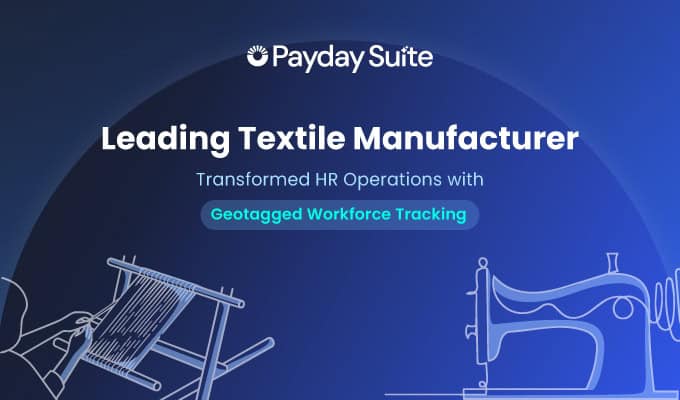
A leading textile manufacturer in India was managing HR operations across multiple locations through spreadsheet-based processes. As the organization scaled to approximately 800 employees across four states, the lack of a centralized HR system led to fragmented data, manual workflows, and limited process visibility. Core HR functions such as attendance, approvals, and payroll depended on manual consolidation, increasing both effort and error risk. A key operational challenge was managing attendance for sales and merchandising representatives who were part of a highly mobile workforce. Existing validation methods relied on WhatsApp location sharing and photo submissions, which lacked reliability, auditability, and scalability. Payday Suite implemented a unified Hire-to-Retire HCM platform, enabling centralized employee data management, workflow automation, payroll compliance, and geotagged attendance tracking. The result was a more structured HR operating model with improved data integrity, workflow visibility, and workforce accountability.
Client Snapshot
Industry: Textile Manufacturing
Region: India
Business Size: ~800 Employees
Geographical Spread: 4 States
Business Need: Digitize HR operations and improve workforce tracking
Core Pain Points: Disconnected systems, manual workflows, lack of attendance validation
Solution Focus: Unified HCM platform, workflow automation, payroll compliance, geotagging
The Challenge
The organization’s HR operations were built on spreadsheet-driven processes that did not scale with business growth.
Employee master data, attendance records, leave management, approval workflows, and payroll inputs were maintained across multiple files and formats. This resulted in fragmented data structures, inconsistent records, and limited data integrity.
HR teams were required to manually consolidate and validate inputs before payroll processing, increasing operational effort and introducing potential inaccuracies.
Workflow management was another key limitation. Approvals were handled through emails and manual follow-ups, creating bottlenecks and reducing transparency.
However, the most critical challenge was workforce tracking.
Sales and merchandising representatives operated as a distributed, mobile workforce with no system-enabled mechanism to validate physical presence at assigned locations.
The existing process relied on:
- WhatsApp-based location sharing
- Photo submissions as proof of visit
- Manual validation by HR teams
This approach lacked:
- System-level validation and auditability
- Reliable and consistent attendance records
- Integration with payroll inputs
- Scalability for a growing workforce
The organization needed a system that could ensure data integrity, automate workflows, and provide verifiable workforce tracking within a single platform.
What the Business Needed
The requirement was centered on building a scalable HR technology foundation.
The organization needed:
- A centralized system to manage employee data across locations
- Structured workflows for approvals and HR processes
- A reliable and verifiable method to track field employee attendance
- Automated payroll with built-in statutory compliance
- Integrated data flows across HR modules
- Real-time visibility into workforce and process status
This marked a shift from manual operations to a system-driven HR model.
Why Payday Suite Was Chosen
Payday Suite was selected because it supported HR operations as an integrated system rather than isolated modules.
Centralized HR Operations
Employee data, attendance, payroll, and workflows were unified into a single platform.
Workflow Automation and Governance
A configurable workflow engine enabled structured approvals, tracking, and auditability.
Payroll Automation with Compliance
Built-in statutory compliance ensured accurate, system-driven payroll processing.
Geotagged Attendance
Mobile employees could mark attendance with location capture, ensuring:
- Verified presence at assigned locations
- Audit-ready attendance records
- Direct integration with payroll
This replaced manual validation with a structured, system-driven approach.
The Implementation Approach
The implementation transitioned the organization from spreadsheets to a system-led HR model.
Phase 1: Data Structuring and Migration
- Data normalization and cleanup
- Master data structuring
- Migration into a centralized system
Phase 2: Workflow Configuration
- Approval workflows
- Leave and attendance processes
- Transaction tracking
Phase 3: Attendance Digitization
- Enabled geotagged attendance
- Ensured location-validated, system-recorded data
- Created audit-ready attendance tracking
Phase 4: Payroll Automation
- Configured payroll structures
- Integrated attendance and employee data
- Enabled automated payroll processing with compliance
The Solution in Practice
Payday Suite became the operational backbone for HR execution.
What Changed for HR
HR teams gained:
- Centralized and structured employee data
- Workflow-driven process execution
- Reduced manual data consolidation
- Integrated attendance and payroll processing
- Real-time visibility into HR operations
What Changed for Employees
Employees gained:
- A system-enabled way to mark attendance
- Reduced dependency on manual proof submission
- Consistent and standardized HR processes
What Changed for Management
Management gained:
- Visibility into workforce movement and activity
- Better control over HR processes
- Access to reliable, system-generated data
Outcomes That Mattered
1. Improved Data Integrity
Centralized data reduced inconsistencies and improved accuracy.
2. Reduced Manual Processing
Automation minimized administrative effort.
3. Faster Payroll Processing
Structured inputs enabled quicker payroll cycles.
4. Enhanced Workforce Visibility
Geotagging enabled real-time validation of employee presence.
5. Better Process Governance
Workflow automation improved tracking, accountability, and auditability.
Benchmark Outcomes
- Up to 40% reduction in manual HR effort
- Up to 50% improvement in attendance validation accuracy
- Up to 30% faster payroll cycle completion
- Up to 35% improvement in approval turnaround time
Why the Project Worked
This implementation succeeded because it addressed both process inefficiencies and system limitations.
Payday Suite enabled the organization to transition from:
- Fragmented data → Centralized system of record
- Manual workflows → Automated process execution
- Unverified attendance → System-validated workforce tracking
- Disconnected operations → Integrated HR ecosystem
This alignment between system capability and operational needs drove adoption and impact.
Conclusion
For this textile manufacturer, Payday Suite enabled a shift from manual HR operations to a structured, system-driven model.
By centralizing employee data, automating workflows, integrating payroll, and enabling geotagged attendance, the organization built a scalable HR foundation.
The result was not just improved efficiency, but a more controlled, visible, and reliable workforce management system.