

Executive Summary
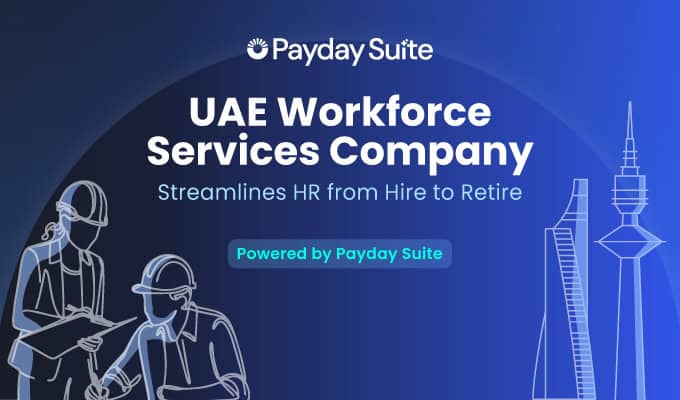
A leading UAE-based workforce services company wanted to modernize HR operations without adding more administrative complexity.
As the business scaled, its HR team was managing onboarding, employee records, attendance, leave, claims, and separation through a mix of manual trackers, disconnected tools, and approval follow-ups. The company needed a more structured HR operating model that could support day-to-day execution while improving visibility for HR and management.
Payday Suite helped the organization bring these moving parts together into one connected platform. The result was a more controlled, transparent, and scalable HR environment across the employee lifecycle.
Client Snapshot
Industry: Workforce Services
Region: UAE
Business Need: Unify HR operations across employee lifecycle stages
Core Pain Points: Manual onboarding, fragmented records, limited attendance visibility, and separation control gaps
Solution Focus: Core HR, onboarding, attendance, ESS, workflows, claims, separation, and reporting
The Challenge
Like many growing service organizations, the company had reached a point where manual coordination was slowing down routine HR work. Onboarding required repeated data entry. Employee information was spread across multiple files and systems. Attendance visibility depended on disconnected inputs, and managers did not always have a live view of workforce activity. Separation and final settlement also needed tighter control.
At the same time, HR wanted stronger structure around probation reviews, leave flexibility, employee claims, and centralized employee records. The issue was not a lack of effort. It was fragmentation.
The company did not need a narrow feature fix. It needed a connected platform that could support a more complete hire-to-retire HR operating model.
What the Business Needed
Requirements were practical and operationally grounded.
The business needed:
- Configurable HR setup, masters, policies, and workflows.
- A real-time dashboard for HR and management visibility
- A richer employee profile with salary history, documents, visa records, and assets
- Bulk upload capability to reduce administrative effort
- OCR-based onboarding to reduce manual data entry
- Probation tracking and review workflows
- Flexible leave handling, including adjustments and early rejoin scenarios
- Claims, salary advances, and loan recovery support
- Controlled separation workflows with clearance and full-and-final settlement tracking
- Biometric API-based attendance integration
- Employee self-service access to attendance visibility
- Standard and custom reporting for HR and management teams
These needs reflect a common pattern in scaling organizations: HR does not just need digital records. It needs operational flow.
Why Payday Suite Was Chosen
Payday Suite stood out because it could support both breadth and control.
Instead of treating onboarding, attendance, employee records, and separation as isolated processes, the platform offered a way to connect them into one operating structure.
This mattered for two reasons.
First, the client needed flexibility. HR policies, employee categories, and process flows were not fully uniform.
Second, the client needed visibility. Leadership and HR teams needed cleaner reporting and clearer workflow ownership.
Payday Suite was a strong fit because it could support:
- Configurable HR master data
- Lifecycle workflows
- OCR-assisted onboarding
- Attendance integration
- ESS visibility
- Structured reporting
In other words, the platform matched the way the business actually operated.
The Implementation Approach
The rollout was phased to keep daily HR operations stable while progressively improving process maturity.
Phase 1: Build the HR Foundation
The first step focused on creating a cleaner HR base.
This included:
- HR setup and master configuration
- Employee structure standardization
- Policy setup
- Workflow configuration
- Bulk upload readiness
This phase mattered because the business needed a reliable foundation before automation could deliver real value. A strong system is only as useful as the structure behind it.
Phase 2: Digitize Onboarding and Strengthen Employee Records
Next, the organization focused on onboarding and data quality.
With OCR-based onboarding, employee information could be captured more efficiently from documents, reducing repetitive manual entry. Employee profiles were also expanded to act as a stronger source of truth for:
- Salary history
- Employee documents
- Visa-related records
- Assets and related HR details
This helped HR move away from fragmented recordkeeping and toward cleaner, profile-based administration.
Phase 3: Improve Attendance Visibility and Employee Access
Attendance was a high-impact area because it affected both operations and employee transparency.
Through biometric API integration, the company improved attendance visibility and reduced dependence on disconnected data pulls. Employees also gained self-service access to attendance information, helping them view late punches, exceptions, and attendance status more directly.
This improved transparency and reduced routine follow-ups to HR.
Phase 4: Strengthen Lifecycle Control and Reporting
The final phase focused on process maturity across the rest of the employee lifecycle.
This included:
- Probation review workflows
- Leave flexibility and adjustment handling
- Claims and advances
- Separation workflows
- Clearance steps
- Full-and-final settlement tracking
- Standard and custom reporting
By this point, the organization had moved from isolated process automation to a more connected HR execution model.
The Solution in Practice
Once implemented, Payday Suite functioned as more than a record system.
It became the operational layer that connected daily HR actions with better control and visibility.
What Changed for HR
HR teams gained:
- One place to manage employee records
- More structured onboarding
- Better workflow ownership
- Improved attendance visibility
- Reduced manual follow-up
- Easier access to reports and dashboards
What Changed for Employees
Employees gained:
- Better visibility into attendance
- Easier access to relevant HR information
- A more consistent process experience across key lifecycle events
What Changed for Managers
Managers gained:
- Cleaner visibility into workforce activity
- Better structure around reviews and approvals
- Improved access to operational data
Outcomes That Mattered
The implementation delivered business value in the areas the client cared about most.
1. Centralized Employee Operations
HR no longer had to rely on scattered files and disconnected process trackers for core employee administration.
2. Faster, Less Manual Onboarding
OCR-assisted onboarding reduced repetitive data entry and helped standardize employee record creation.
3. Better Attendance Visibility
Biometric integration and ESS access improved transparency and reduced avoidable attendance follow-up.
4. Stronger Lifecycle Control
Probation, leave handling, claims, and separation became easier to manage through structured workflows.
5. Better Management Reporting
Dashboards and reporting capabilities gave leadership better visibility into workforce activity and HR operations.
6. Improved Scalability
As the business continued to grow, HR operations became easier to manage because processes, records, and reporting were aligned in one platform.
Why the Project Worked
This rollout worked because it focused on operational pain points, not just software features.
The business did not need a long list of modules. It needed better execution across the processes that HR was already managing every day.
Payday Suite helped connect those processes:
- Onboarding
- Employee records
- Attendance
- Leave
- Claims
- Probation
- Separation
- Reporting
That made the HR model more practical, controlled, and scalable.
Conclusion
For this UAE workforce services company, the real value of Payday Suite was not just automation.
It was control.
By bringing together onboarding, employee records, attendance, ESS, workflows, and separation into one connected HR platform, the business created a more stable operating model for growth.
If your HR team is still managing critical employee processes across multiple tools and manual follow-ups, Payday Suite can help bring those workflows together into one clearer system.